
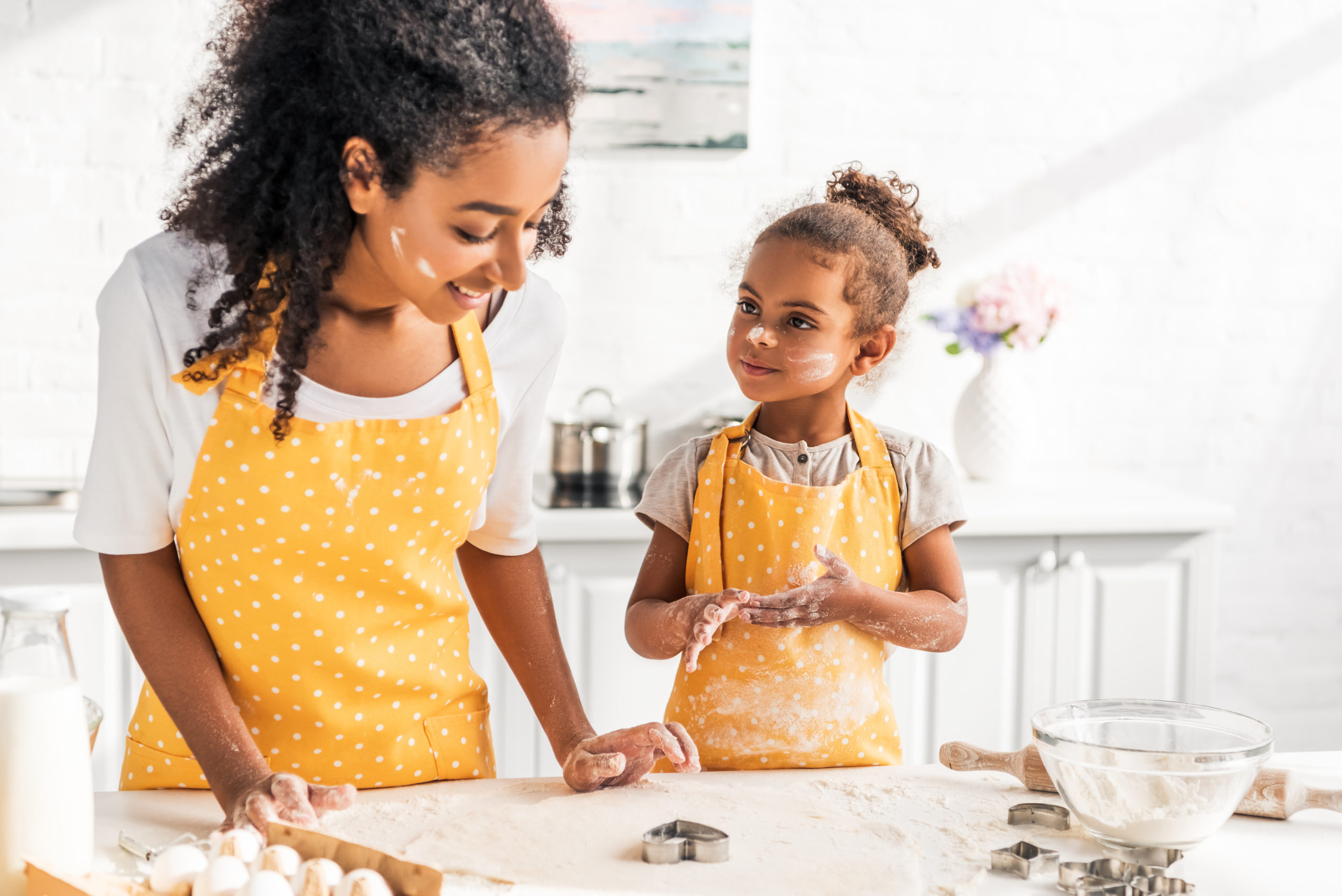
african american mother and daughter preparing cookies with molds together in kitchen

The Kitchen as the Classroom

Including kids in cooking and baking can teach them a lot more than just what ingredients go into the food they eat, it can also teach them about math, science and reading, among other things.

Sure, including kids in preparing meals and baked goods can add time and mess, but at the end of it you get to enjoy a tasty meal or treat together. Time in the kitchen also gives kids the chance to learn a few things. Here are just a few examples:


  1. Math. You learn to count. You learn that you can divide a cup into fourths — or thirds. You learn what it means to halve a recipe.
  2. Science. Baking is a science experiment! What happens when you mix all these things together — and then put them in the oven? What about when you remove an ingredient? What does that tell you about why it is included in the recipe?
  3. Reading. What important skill do you need to follow a recipe? Reading, of course! Reading in a real-life context helps kids understand what they’re reading better.
  4. Following directions. Following every step — in order — makes a real difference. Kids learn why this is so important when they follow a baking recipe.
  5. Problem solving. Made a mistake? No need to panic! Just stop a moment and think about how you can solve that problem. Maybe there’s a creative way to save those cookies.
  6. Patience. Baking teaches your child that the best things are worth waiting for.

For more tips about baking visit homebaking.org.

Courtney Gaine, PhD, RD

Courtney Gaine, PhD, RD

Courtney Gaine, Ph.D., R.D., is the President and CEO for the Sugar Association in Washington, D.C. Prior to this appointment in January 2016, Dr. Gaine served as the Vice President of Scientific Affairs at the association. Dr. Gaine previously served as senior science program manager at the North American branch of the International Life Sciences Institute (ILSI North America), a public, nonprofit scientific foundation that advances the understanding and application of science related to the nutritional quality and safety of the food supply. Prior to ILSI, Dr. Gaine held positions of project director, nutrition and wellness, at the nonprofit organization Convergence and science manager at FoodMinds, a public relations firm. She began her career in academia as an assistant professor at East Carolina University. A native Washingtonian, Dr. Gaine obtained her Ph.D. in nutritional sciences and biochemistry and bachelor’s degree in dietetics from the University of Connecticut, where she was also a co-captain of the UConn women’s basketball team.

Scroll to Top