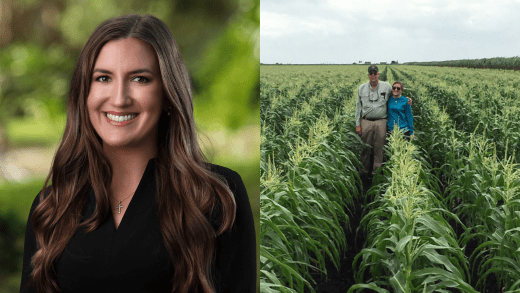
Fourth-Generation Florida Farmer Carries on Family Legacy in Pahokee
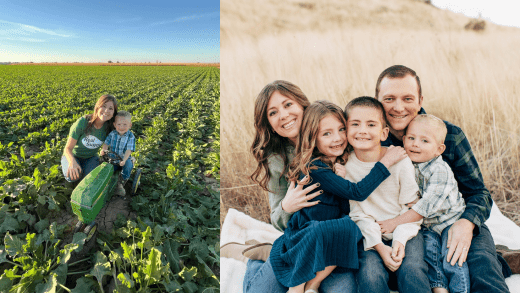
When tragedy struck her family, 13-year-old Olivia Pope Helms made a promise: she would carry on her brother’s dream by building a future in agriculture.
Fifteen years later, the fourth-generation agriculturist is doing exactly that—and transforming sustainable farming in Florida’s Everglades Agricultural Area. Her older brother, Edward Lewis “E.L.” Pope IV, was just 21 when he passed away in a car accident. He had planned to join the family farming operation, Pope Farms, after attending the University of Florida (UF) for a degree in agriculture.
“I am the youngest of five children and E.L. was our only brother,” said Helms, 28. “In the midst of that loss, I felt a strong pull to continue what he started. Farming doesn’t stop, and carrying on his dream became a way for me to keep his spirit alive.”
A Century of Agricultural Heritage in the Everglades Agricultural Area
Helms is proud to be part of a family farming legacy that started when Edward Lewis Pope, Sr., left Mississippi. He arrived in Pahokee in 1926, armed with an agriculture degree from Mississippi State University, experience as a produce salesman, and a strong work ethic.
“Pahokee is a Seminole word that means ‘grassy water,’” Helms said. “This name was given to the area on the southeast shore of Lake Okeechobee because sawgrass grew there back in the day.”
The soil around Lake Okeechobee was filled with sand and organic material. It provided ideal conditions for vegetables and sugarcane. Pope began growing sweet corn and green beans, later adding sugarcane and cabbage in the early 2000s, and joined Sugar Cane Growers Cooperative of Florida. The farm is located in the Everglades Agricultural Area (EAA) in Palm Beach County, a region that is now the winter vegetable capital of the U.S.
Today, nearly 100 years later, Pope Farms is comprised of Helms’ father, Edward Lewis Pope III and her uncle, Walter Pope. After graduating from high school, Helms decided to follow in E.L.’s footsteps and attend UF for agriculture.
“I wanted to carry on what he started, and my dad encouraged me to attend UF to broaden my knowledge of Florida’s unique agriculture,” Helms said. “I received my bachelor’s in Agribusiness in 2019 and master’s in business management in 2020.”
Growing Up on a South Florida Family Farm
Growing up on the family farm, Helms always knew agriculture would be her life’s work.
“It’s what I’ve always known, and I have great memories of riding along with my dad and living on the same street as my grandparents, aunts, uncles, and cousins in Pahokee,” she said. “As a kid, I always enjoyed keeping the blackbirds out of the corn crop. One Christmas, my siblings, cousins, and I spent the day protecting a field that was set to be harvested the next day. That Christmas with my family is one of my favorite memories.”
Florida farmers are resilient, and Helms and her family have weathered many storms together over the years.
“There are many challenges to farming here in the EAA because we are greatly exposed to the elements and never know how much rain we will get. This is also the first year I can remember that we did not have a hurricane threat,” she said. “Temperatures can sometimes dip below freezing, which can pose serious problems. When that happens, we hire helicopters to fly over the fields and push warm air down onto the crops.”
Building a Career in Florida Agriculture
After graduating from UF, Helms returned home. She started her career with Wedgworth’s Inc., a family-owned company that is Florida’s largest custom fertilizer dealer for agricultural and turf industries. Wedgworth’s also provides precision-based soil sampling and fertilizer application technology to help maximize crop yields and efficiency for customers and owns and operates a 10,000-acre sugarcane farm in the EAA.
“I wear a few different hats at Wedgworth’s. I am the credit and marketing manager. I also oversee regulatory, community relationships, and event coordination,” Helms said. “My job is both challenging and rewarding, and can best be described as facilitating relationships to help find solutions. One of the biggest challenges is supporting growers first while also being mindful of the needs of the business in today’s ag environment of high input costs. The greatest reward is being able to help farmers, especially after a crisis like a hurricane or freeze event.”
Advocating for Sustainable Farming and Environmental Stewardship
Advocating for agriculture is also a top priority for Helms, both as an agriculturist and as the next generation of Pope Farms. She joined the UF Collegiate Farm Bureau and completed an internship at the Florida Farm Bureau state office during college, was a member of the Young Farmers and Ranchers State Leadership group, and serves on the Western Palm Beach County Farm Bureau Board of Directors.
“Most people don’t realize that, after tourism, agriculture is the second largest revenue source in Palm Beach County. Farmers here are a small representation of a large county, so we need to have a big voice and work hard to make our voices heard,” she said. “I love telling the story of EAA farmers, how we’re protecting the land, and the passion we have for agriculture.”
Glades farmers are among the most sustainable and reliable producers of safe, locally grown produce in the world, according to Helms. They have been highly successful at reducing phosphorus, consistently exceeding the 25 percent annual reduction mandated by the Everglades Forever Act. On average, they have achieved a 57 percent annual reduction since 1996 and reported a 62 percent reduction for the most recent water year. This success is due to their implementation of Best Management Practices (BMPs), guidelines developed through the University of Florida, to advise producers on how to manage the water, nutrients, and inputs they use to reduce impact on the state’s natural resources. These BPMs include precision fertilizer application, laser-leveled fields, and improved drainage management, which prevent soil and phosphorus from entering waterways.
Sharing the exciting story of Florida sugarcane has taken Helms to the state capital in Tallahassee as well as Capitol Hill. “Not all lawmakers fully understand the legislation they are involved with, so it is great to be able to give them a better understanding of who farmers are and what we do,” she said. “We show them how American sugar comes from various sources across the country from farmers who are all working toward a common goal: producing the highest quality product for consumers while being good stewards of the land.”
Inspiring the Next Generation of Agricultural Leaders
Helms not only works to secure the future of her family’s farm but also the bright future of farming in Florida for generations to come by educating students of all ages about agriculture.
“I want to give them a great view of agriculture by showing them the wide range of exciting opportunities it offers, from production to the STEM side,” she said. “They don’t need to leave the area to find success.”
Helms wants to encourage all young people who have a desire to work in agriculture.
“There is a misconception that you have to come from a multigenerational farm family in order to be able to farm, but that’s not true,” she said. “Don’t give up and don’t get discouraged, there is a place for you. Hold on to your passion because through hard work and networking, you can find a place you may not have known existed. American agriculture needs your fresh mind and unique perspective.”
In addition to being her life’s work, agriculture is also a favorite pastime for Helm. In her free time, she enjoys gardening, fishing with her husband Kyle, and chasing their three German shorthaired pointers.

Get Social with #MoreToSugar